
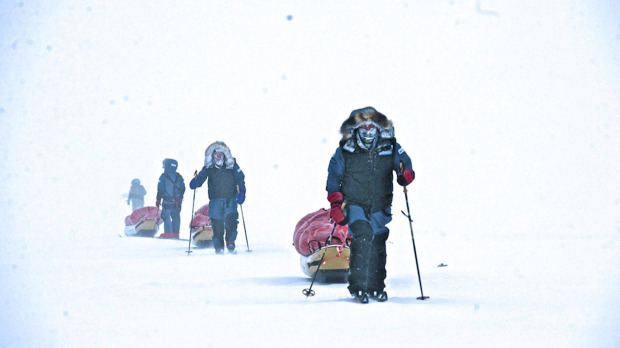
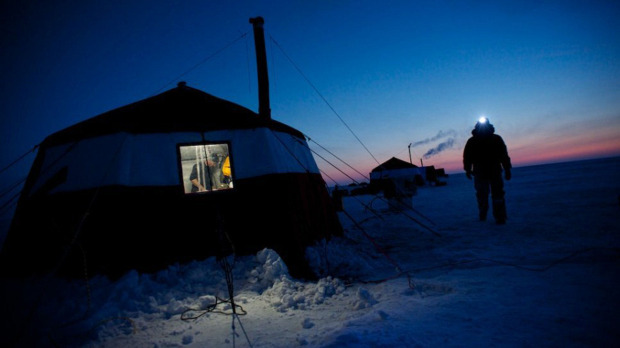
Four explorers from the Catlin Expedition's team finished the first phase of their trek this Tuesday, reaching an ice base off the western coast of Nunavut's Ellef Ringnes island. The nearest airstrip is about 25 kilometres away, at Isachsen
(Photo by Martin Hartley)
Friday, March 25, 2011 – Globe and Mail
ANNA MEHLER PAPERNY
A series of holes hand-drilled into Arctic ice in the middle of a snowstorm at -40 degrees could shed light on everything from northern resource extraction to polar sovereignty to determining weather patterns in Western Europe and the South Pacific.
At least, that’s what a team of daredevil researchers is hoping.
The group has set up camp 25 kilometres offshore from a landing strip in Isachsen, Nunavut, to spend weeks studying the effects of ice melt on global ocean currents during the Arctic’s most punishing season. Their base consists of steel-and-nylon tents designed to maintain enough heat to keep equipment and humans warm amid a punishing spring squall and whiteout conditions.
“Because we’re there, intimately, on the sea ice, in spots that otherwise can’t be accessed, we’re potentially getting data that isn’t possible by any other means,” says Adrian McCallum, an Australian finishing his PhD at Cambridge’s Scott Polar Research Centre.
Over the next several weeks, he’ll sledge from the North Pole to Greenland, drilling holes through sea ice as he goes, measuring everything from ice thickness to the temperature and salinity of the water.
This expedition, now in its third year, is funded by Catlin Group – an insurer and underwriter that won’t disclose what it pays for the Arctic odyssey except to say the price tag runs well over $1-million.
It’s a smart PR move: It puts the company’s name on a high-profile scientific expedition with global appeal. But when you’re in the risk-management business, Catlin Group spokesman Jim Burcke says, it pays to know how a melting pole is going to change shipping, weather and ocean currents globally.
The work the company is backing is pricey and perilous, but researchers argue it is becoming increasingly imperative for anyone with a stake in what goes on up north.
That would include Canada. But despite recent increases in funding, Canada still lags its polar neighbours when it comes to scientific research.
“In some ways we’re doing, probably, better than we have been,” says Greg Poelzer, director of the University of Saskatchewan’s International Centre for Northern Governance and Development. “But we aren’t where we need to be.”
In 2005, Canada’s funding for Arctic research was about one-tenth that of the United States, which clocked in at $300-million for 2005-2006, says Louis Fortier, scientific director of Laval-based ArcticNet. It has since increased, but he still figures that Canadian researchers publish just over half the number of Arctic-related papers as their U.S. counterparts.
Meanwhile, corporate interest in the North is ramping up – so much so that researchers have trouble getting increasingly sought-after spots on icebreakers.
It’s not just fellow polar countries, either: Canadian researchers are vying with scientists from China and South Korea, who realize how important Arctic knowledge is to their own economic and strategic interests.
Meanwhile, Canada’s High Arctic Research Station, first announced in 2007 and given funding in the 2009 and 2010 federal budgets, has only just completed its feasibility study this month, although it remains unpublished; design and building are expected to take years.
Research funding that spiked to $156-million over a six-year period spanning the “International Polar Year” in 2009 has since dropped. No funds are earmarked for Arctic research in the 2011 budget.
“Funding has not continued at the same level … enough that Arctic scientists are expressing concern, and in some cases they can’t actually do their research as they had been able to before,” UBC professor Michael Byers says. “We end up doing our science on a shoestring.”
For more than two years, Ottawa’s primary Arctic research body was without a president or a board. The Polar Commission remedied that last November, executive director Steven Bigras says, which will allow the federal agency to set a broad research agenda going forward.
But at the same time, Mr. Bigras says, things are changing so quickly that scientists’ models are outdated almost as soon as they enter a year’s data. “The models just can’t keep up with the rate [ice is] actually disappearing.”

Researchers have already found Arctic ice is melting at rapid rates. What they're still trying to determine is what that means – not only for business, transport and tourism in a newly navigable North, but also for oceans and climates around the world. If melting ice and warming waters change the salt- and heat-driven thermohaline currents traversing the globe, it could change sea levels and temperatures anywhere from Western Europe to islands in the South Pacific.
(Photo by Martin Hartley; text by Anna Mehler Paperny)

In the next phase of their trek, as they spend every day sledging from the North Pole to Greenland, researchers will drill holes in the ice to take data samples on everything from temperature and density to depth and current speed. They'll pass the results they get to the National Oceanography Centre in Southampton, UK.
(Photo by Martin Hartley; text by Anna Mehler Paperny)

At the same time, researchers at the ice base are taking samples to get a sense of how carbon dioxide levels are affecting the fluctuating springtime ice.
"It's definitely a difficult time of year, but that's what makes the data so interesting and so critical," says Kristina Brown, a PhD candidate from the University of British Columbia. "There's not a lot of samples to compare to, so everything we’re doign is essentially helping us get a better idea of the picture because we’re adding to such a small body of it so far."
(Photo by Martin Hartley; text by Anna Mehler Paperny)

Research like this should be a priority for Canada, says Louis Fortier, the scientific director of ArcticNet. The Laval-based group is a national hub for northern research. Its seven-year funding was renewed late last year.
“The Arctic is the new frontier," Prof. Fortier says. "It’s where you have new resources you can exploit, geopolitical questions that are very important. … We’re going to shift the climate of the northern hemisphere the day the sea ice melts completely.
“We need to prepare for all these things. … We would look like a backwards country if we didn’t match up that effort internationally.”
(Photo by Martin Hartley; text by Anna Mehler Paperny)
Plenty of other countries are sitting up and taking notice: Other polar nations such as Norway, Finland and Sweden -- not to mention such powerhouses as Russia and the United States -- have extensive research networks. But so, too, do less obvious countries.
"Some of our non-traditional partners -- South Korea, China -- they're very interested in what's going on in the Arctic, as well," says Steven Bigras, executive director of the Canadian Polar Commission. "They've put substantial funds forward. They're looking at whate everybody else is: They're looking at climate change, they're looking at biodiversity, theyre looking at fishing stocks, therye looking at economic potential."
(Photo by Martin Hartley; text by Anna Mehler Paperny)
What researchers know
Ice is melting – and quickly. In a matter of years, the High Arctic could be ice-free during the summer months. At the same time, the permafrost on which northern infrastructure relies is vanishing, presenting new challenges for the most basic aspects of northern life.
What they don’t know
What that rapid warming and ice melt mean – not only for business, transport and tourism in a newly navigable North, but also for oceans and climates around the world. If melting ice and warming waters change currents traversing the globe, it could change sea levels and temperatures anywhere from Western Europe to islands in the South Pacific.
Why it matters
“The Arctic is the new frontier. It’s where you have new resources you can exploit, geopolitical questions that are very important. … We’re going to shift the climate of the Northern Hemisphere the day the sea ice melts completely,” says Louis Fortier, scientific director of ArcticNet, a national hub of northern research.
What Canada is doing
More than it has in the past, but not as much as other countries. Funding spiked around International Polar Year, when Ottawa pledged $156-million to Arctic research over six years.
The government has also pledged $75-million over five years toward a Geo-mapping for Energy and Minerals program; $8-million over two years for monitoring in Nunavut and the Northwest Territories and $22-million over five years for research informing potential oil and gas activities in the Beaufort Sea.
A $2-million feasibility study into a High Arctic Research Station was completed this month; Ottawa has put $18-million toward its design.
Anna Mehler Paperny




 a business of misfits