

June 16, 2014 – Anna Mehler Paperny, Global News
Federal Health Minister Rona Ambrose is considering requiring certain prescription drugs be tamper-resistant – and she wants to know what you think.
June 16, 2014 – Anna Mehler Paperny, Global News
Federal Health Minister Rona Ambrose is considering requiring certain prescription drugs be tamper-resistant – and she wants to know what you think.
Rebecca Lindell and Anna Mehler Paperny, Global News
This isn’t the first slew of suggestions on how to tackle Canada’s “crisis” in prescription opioid misuse. But many hope it’ll be the last.
A report released Wednesday by the Canadian Centre for Substance Abuse culminates a year-long mind-meld of people representing almost every group in the country with a stake in stopping painkillers from creating addicts, drug dealers and deaths.
Anna Mehler Paperny, Global News
Ontario Health Minister Deb Matthews wants to re-examine who’s allowed to prescribe opioids, how they prescribe them and what pills the government pays for.
The drop in OxyContin and its replacement OxyNEO is “a success,” she told Global News in an interview Tuesday. But “there’s more to be done. … Who should be able to prescribe these drugs? What form is the right form? These are very important questions.”

Click to compare Canada’s hydromorph contin consumption with the rest of the world.
Anna Mehler Paperny, Global News
Health Canada rattled nerves south of the border last fall when it approved generic versions of OxyContin.
United States drug czar Gil Kerlikowske issued an alert to law-enforcement agencies, warning that “the potential exists for diversion into the United States because the old formulations, which are easier to abuse, are unavailable in the United States,” the Wall Street Journal reported.
“This alert seeks to raise awareness of this change with law enforcement along the Northern Border so law enforcement and border officials can work jointly to prevent diversion.”
Photo by Michelle Siu for the Globe and Mail
Anna Mehler Paperny, Global News
A year after provincial governments clamped down on the most notorious name in prescription-drug abuse, other, more powerful, less regulated opioids are filling the void – with sometimes fatal results.
OxyContin’s off the market, its tamper-resistant replacement tougher to get. But Canadians are popping more pills than ever: In 2010, for the first time, Canada edged past the United States to become the highest opioid-consuming country, per capita, in the world.
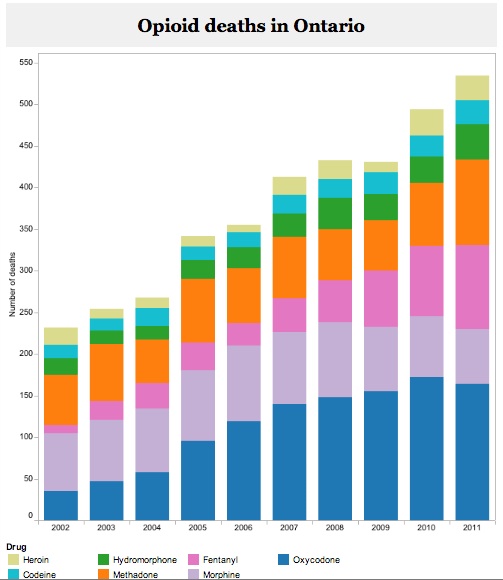
And more Canadians are dying from it: In 2011, twice as many Ontarians were killed by opioid overdoses as drivers killed in car accidents, according to coroner’s statistics given to Global News. That toll has more than tripled since 2002.
Anna Mehler Paperny, Global News
Purdue Pharmaceuticals markets a long-acting, non-tamper resistant opioid in Canada but argues that another long-acting, non-tamper resistant opioid in the U.S. is too dangerous to approve.
In an 80-page submission to the U.S. Food and Drug Administration last July – quoting Ontario Health Minister Deb Matthews, among several others – Purdue argued that allowing generic versions of OxyContin on the market without tamper-proofing mechanisms “would have a number of detrimental effects and would be flatly inconsistent with the Agency’s mission to promote and protect the public health.”

Michelle Siu for the Globe and Mail
Saturday, July 7, 2012 – Globe and Mail
ANNA MEHLER PAPERNY
Ontario is “strongly urging” the federal government not to let generic brands of the popular painkiller OxyContin into Canada once Purdue Pharmaceuticals’ patent runs out this fall.
The expiration of Purdue’s OxyContin patent on Nov. 25 opens the door for other companies to manufacture cheaper generic versions of the controlled-release oxycodone. Purdue will continue to make a new, tamper-resistant patented drug – OxyNEO – introduced to replace OxyContin earlier this year.

Photo by Moe Doiron/The Globe and Mail
Ontario Health Minister Deb Matthews says the province has no immediate plans to put Suboxone on the Ontario Drug Benefit, which would make it more readily available to treat addicts who can’t get methadone, a more common treatment for opioid addiction. Health-care practitioners, especially in remote areas, want to use Suboxone more in cases where there are simply no licensed methadone doctors around, or no spaces available. Buprenorphine, the active ingredient in Suboxone, is supposed to be safer and easier for others (nurses, for example) to give out. It’s also really expensive.

Photo by Michelle Siu for the Globe and Mail
Tuesday, March 6, 2012 – Globe and Mail
ANNA MEHLER PAPERNY
A Northern Ontario coroner says the province’s doctors and pharmacists need to take extra care in switching patients from OxyContin to other opioids, following the death of a man whose doctor changed his prescription and gave him an incorrect dose.

Photo by Michelle Siu for the Globe and Mail
Tuesday, February 21, 2012 – Globe and Mail
ANNA MEHLER PAPERNY
Nova Scotia has become the latest province to clamp down on OxyContin prescriptions, with Health Minister Maureen MacDonald announcing the province will only pay for the potent painkiller’s replacement in extenuating circumstances – for cancer-related pain or palliative care.
Nova Scotia’s move comes days after Ontario, with the highest rates of prescription-opioid addiction in the country, announced it is tightening rules for the painkiller.
Physicians called the move a step forward, but warned that changing publicly funded drug plans won’t be nearly enough to stem abuse from the prescription drug.
“There is a lot more that needs to be done,” said David Juurlink, a drug-safety specialist at Sunnybrook Hospital in Toronto. “These drugs should be harder to obtain, harder to prescribe – and certainly at high doses.”
 a business of misfits