
Researchers are busy in Canada’s Arctic – but few are Canadian

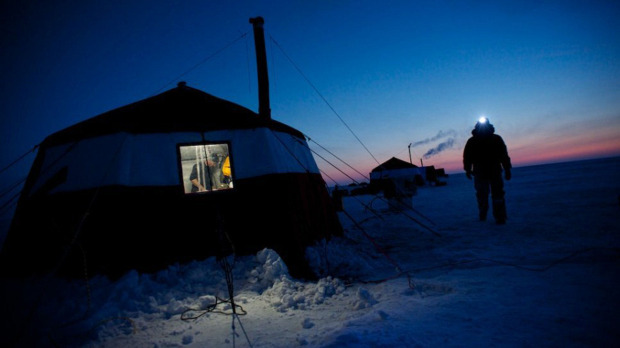
Four explorers from the Catlin Expedition's team finished the first phase of their trek this Tuesday, reaching an ice base off the western coast of Nunavut's Ellef Ringnes island. The nearest airstrip is about 25 kilometres away, at Isachsen
(Photo by Martin Hartley)

Friday, March 25, 2011 – Globe and Mail
ANNA MEHLER PAPERNY

A series of holes hand-drilled into Arctic ice in the middle of a snowstorm at -40 degrees could shed light on everything from northern resource extraction to polar sovereignty to determining weather patterns in Western Europe and the South Pacific.

At least, that’s what a team of daredevil researchers is hoping.

The group has set up camp 25 kilometres offshore from a landing strip in Isachsen, Nunavut, to spend weeks studying the effects of ice melt on global ocean currents during the Arctic’s most punishing season. Their base consists of steel-and-nylon tents designed to maintain enough heat to keep equipment and humans warm amid a punishing spring squall and whiteout conditions.

“Because we’re there, intimately, on the sea ice, in spots that otherwise can’t be accessed, we’re potentially getting data that isn’t possible by any other means,” says Adrian McCallum, an Australian finishing his PhD at Cambridge’s Scott Polar Research Centre.

Over the next several weeks, he’ll sledge from the North Pole to Greenland, drilling holes through sea ice as he goes, measuring everything from ice thickness to the temperature and salinity of the water.

This expedition, now in its third year, is funded by Catlin Group – an insurer and underwriter that won’t disclose what it pays for the Arctic odyssey except to say the price tag runs well over $1-million.

It’s a smart PR move: It puts the company’s name on a high-profile scientific expedition with global appeal. But when you’re in the risk-management business, Catlin Group spokesman Jim Burcke says, it pays to know how a melting pole is going to change shipping, weather and ocean currents globally.

The work the company is backing is pricey and perilous, but researchers argue it is becoming increasingly imperative for anyone with a stake in what goes on up north.

That would include Canada. But despite recent increases in funding, Canada still lags its polar neighbours when it comes to scientific research.

“In some ways we’re doing, probably, better than we have been,” says Greg Poelzer, director of the University of Saskatchewan’s International Centre for Northern Governance and Development. “But we aren’t where we need to be.”

In 2005, Canada’s funding for Arctic research was about one-tenth that of the United States, which clocked in at $300-million for 2005-2006, says Louis Fortier, scientific director of Laval-based ArcticNet. It has since increased, but he still figures that Canadian researchers publish just over half the number of Arctic-related papers as their U.S. counterparts.

Meanwhile, corporate interest in the North is ramping up – so much so that researchers have trouble getting increasingly sought-after spots on icebreakers.

It’s not just fellow polar countries, either: Canadian researchers are vying with scientists from China and South Korea, who realize how important Arctic knowledge is to their own economic and strategic interests.

Meanwhile, Canada’s High Arctic Research Station, first announced in 2007 and given funding in the 2009 and 2010 federal budgets, has only just completed its feasibility study this month, although it remains unpublished; design and building are expected to take years.

Research funding that spiked to $156-million over a six-year period spanning the “International Polar Year” in 2009 has since dropped. No funds are earmarked for Arctic research in the 2011 budget.

“Funding has not continued at the same level … enough that Arctic scientists are expressing concern, and in some cases they can’t actually do their research as they had been able to before,” UBC professor Michael Byers says. “We end up doing our science on a shoestring.”

For more than two years, Ottawa’s primary Arctic research body was without a president or a board. The Polar Commission remedied that last November, executive director Steven Bigras says, which will allow the federal agency to set a broad research agenda going forward.

But at the same time, Mr. Bigras says, things are changing so quickly that scientists’ models are outdated almost as soon as they enter a year’s data. “The models just can’t keep up with the rate [ice is] actually disappearing.”

Researchers have already found Arctic ice is melting at rapid rates. What they're still trying to determine is what that means – not only for business, transport and tourism in a newly navigable North, but also for oceans and climates around the world. If melting ice and warming waters change the salt- and heat-driven thermohaline currents traversing the globe, it could change sea levels and temperatures anywhere from Western Europe to islands in the South Pacific.
(Photo by Martin Hartley; text by Anna Mehler Paperny)

In the next phase of their trek, as they spend every day sledging from the North Pole to Greenland, researchers will drill holes in the ice to take data samples on everything from temperature and density to depth and current speed. They'll pass the results they get to the National Oceanography Centre in Southampton, UK.
(Photo by Martin Hartley; text by Anna Mehler Paperny)

At the same time, researchers at the ice base are taking samples to get a sense of how carbon dioxide levels are affecting the fluctuating springtime ice.
"It's definitely a difficult time of year, but that's what makes the data so interesting and so critical," says Kristina Brown, a PhD candidate from the University of British Columbia. "There's not a lot of samples to compare to, so everything we’re doign is essentially helping us get a better idea of the picture because we’re adding to such a small body of it so far."
(Photo by Martin Hartley; text by Anna Mehler Paperny)

Research like this should be a priority for Canada, says Louis Fortier, the scientific director of ArcticNet. The Laval-based group is a national hub for northern research. Its seven-year funding was renewed late last year.
“The Arctic is the new frontier," Prof. Fortier says. "It’s where you have new resources you can exploit, geopolitical questions that are very important. … We’re going to shift the climate of the northern hemisphere the day the sea ice melts completely.
“We need to prepare for all these things. … We would look like a backwards country if we didn’t match up that effort internationally.”
(Photo by Martin Hartley; text by Anna Mehler Paperny)

Plenty of other countries are sitting up and taking notice: Other polar nations such as Norway, Finland and Sweden -- not to mention such powerhouses as Russia and the United States -- have extensive research networks. But so, too, do less obvious countries.
"Some of our non-traditional partners -- South Korea, China -- they're very interested in what's going on in the Arctic, as well," says Steven Bigras, executive director of the Canadian Polar Commission. "They've put substantial funds forward. They're looking at whate everybody else is: They're looking at climate change, they're looking at biodiversity, theyre looking at fishing stocks, therye looking at economic potential."
(Photo by Martin Hartley; text by Anna Mehler Paperny)

What researchers know

Ice is melting – and quickly. In a matter of years, the High Arctic could be ice-free during the summer months. At the same time, the permafrost on which northern infrastructure relies is vanishing, presenting new challenges for the most basic aspects of northern life.

What they don’t know

What that rapid warming and ice melt mean – not only for business, transport and tourism in a newly navigable North, but also for oceans and climates around the world. If melting ice and warming waters change currents traversing the globe, it could change sea levels and temperatures anywhere from Western Europe to islands in the South Pacific.

Why it matters

“The Arctic is the new frontier. It’s where you have new resources you can exploit, geopolitical questions that are very important. … We’re going to shift the climate of the Northern Hemisphere the day the sea ice melts completely,” says Louis Fortier, scientific director of ArcticNet, a national hub of northern research.

What Canada is doing

More than it has in the past, but not as much as other countries. Funding spiked around International Polar Year, when Ottawa pledged $156-million to Arctic research over six years.

The government has also pledged $75-million over five years toward a Geo-mapping for Energy and Minerals program; $8-million over two years for monitoring in Nunavut and the Northwest Territories and $22-million over five years for research informing potential oil and gas activities in the Beaufort Sea.

A $2-million feasibility study into a High Arctic Research Station was completed this month; Ottawa has put $18-million toward its design.

Anna Mehler Paperny
In Fukushima’s aftermath, Canada’s nuclear industry girds for change

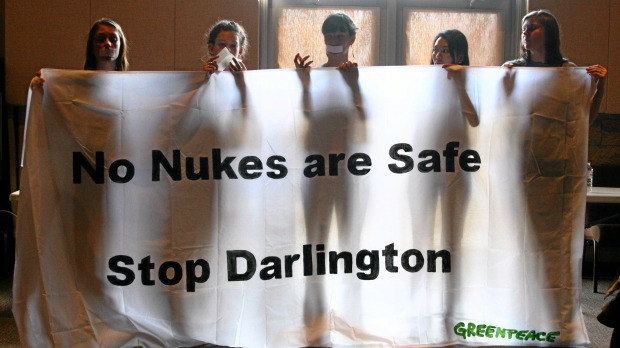
Greenpeace protesters hold up a banner to disrupt the second day of hearings into four proposed nuclear reactors in Ontario.
(Photo by Anand Maharaj/The Canadian Press)

Wednesday, March 23, 2011 – Globe and Mail
ANNA MEHLER PAPERNY

Nuclear energy operators should prepare to face greater scrutiny and meet higher demands for safety precautions after the crisis in Japan, according to one of the industry’s major Canadian players.

“I would expect some changes; I just don’t know what those changes are,” says Alun Richards, a spokesman for Areva Canada, the nuclear developer whose operations range from mining uranium ore to building reactors and storing spent fuel.

Areva is preparing a feasibility study into Nunavut’s first uranium mine, at Baker Lake, even as community consultations this month reveal mounting opposition to the proposal.

Continue reading

Pharma giant’s expansion could be a prescription for a better economy

ANNA MEHLER PAPERNY 
Friday, March 04, 2011 – Globe and Mail

The wannabe lifesaving vaccines of the future are being test-driven on a treed campus in Toronto’s north end.

Here, in Sanofi Pasteur’s Canadian headquarters near Dufferin and Steeles, serums vaccines go from painstaking prototypes to mass-produced doses ready to be shipped worldwide. It’s a good time to be in the inoculation business – even for a site that’s been doing it for a century.

The vaccine giant’s made-in-Toronto breakthrough, a five-component shot protecting kids from whooping cough, has proven a billion-dollar international hit – so much so that the company is building a new $180-million manufacturing plant to keep up with exponentially growing demand.

But that’s just the beginning: Over the next 15 years, Sanofi Pasteur hopes to develop now largely fallow areas of its campus, land currently occupied primarily by trees and a couple of storage facilities.

Continue reading

The quandary facing Rob Ford’s budget chief

ANNA MEHLER PAPERNY
Friday, February 18, 2011 – Globe and Mail

Mike Del Grande is having a rough day.

It’s been madness since he got in at 7:30 a.m., he says: Meetings with the mayor, chasing down councillors and staff, dealing with endless phone calls and supplications. It’s barely noon, and the city’s budget chief looks world-weary against a backdrop of budgetary binders and Knights of Columbus certificates.

But he likes the gig, right? Head of the budget he spent the David Miller years picking through and railing against?

“Do I like the job?” He grimaces. “That’s a relative word. I have a hard job. And I have a job that is not enviable. But I’m not afraid to roll up my sleeves.”

Continue reading

Doug Ford’s big ambitions for his little brother

Thursday, February 17, 2011
ANNA MEHLER PAPERNY

Since he swept into office, Mayor Rob Ford and his older brother, Councillor Doug Ford, have established a highly centralized administration that holds the reins of power tightly.

Not tightly enough, Doug Ford said in an interview this week.

“I believe in a strong mayor system, like they have in the States. The mayor should have veto power … so he has enough power to stop council,” Mr. Ford said. “The mayor should be the mayor. At the end of the day … the mayor’s responsible for everything.”

Continue reading

Man accused of killing officer was a trained snowplow operator

Richard Esber Kachkar (front, centre) was a diligently trained snowplow student, thanks to a program paid for by the Ontario government.
(Photo by Anna Mehler Paperny, courtesy of Cat Duly-Lisle)

ANNA MEHLER PAPERNY AND JILL MAHONEY 
Friday, January 14, 2011 – Globe and Mail

ST. CATHARINES, ONT. AND TORONTO — Richard Esber Kachkar, who police allege drove the snowplow that killed Sergeant Ryan Russell, would have been no stranger to that kind of heavy machinery.

For 10 hours a day, five days a week over three months, Mr. Kachkar trained to use heavy machinery at the St. Catharines campus of Transport Training Centres, a program his instructor said was funded by the Ontario government.

And, according to the woman who taught him how to control the heavy, complex machinery, the 44-year-old Mr. Kachkar was an able student.

“He was very conscientious,” Cat Duly-Lisle said. “He was so careful.”

Continue reading

The death of Sergeant Ryan Russell: Owner of stolen snowplow haunted by officer’s death

Friday, January 14, 2011 – Globe and Mail
PATRICK WHITE, GREG McARTHUR and ANNA MEHLER PAPERNY

Toronto and St. Catharines, Ont. — A day after he watched his stolen plow-truck lurch away on an ill-fated path up Parliament Street, Daniel Da Silva can’t purge the memory or the guilt.

“I keep thinking about it,” he said, a day after the truck ricocheted through downtown streets with a troubled man behind the wheel, eventually crushing and killing 35-year-old Toronto police Sergeant Ryan Russell. “I don’t know what else I could have done to stop him.”

Continue reading

Vermin, vandalism and the vertical slum: Toronto as city of high-rise poverty

Rebecca Pilgrim stands in the kitchen of her apartment on the 14th floor of a high rise building in Toronto's east end.
(Photo by Chris Young for The Globe and Mail)

Wednesday, January 12, 2011 – Globe and Mail
ANNA MEHLER PAPERNY

The apartment high-rise capital of Canada is increasingly becoming a city of vertical poverty. More than ever, Toronto’s low-income population is concentrated not only by neighbourhood but by building – in the 50-year-old concrete slab towers clustered around the inner suburbs, according to numbers provided to The Globe and Mail.

Many are decrepit and crumbling; their elevators are so unreliable that a United Way report coming out Wednesday calls for a task force specifically targeting their repair. Thousands of interviews with residents indicate these buildings have grown notorious for vermin and vandalism.

But the 1,000 privately owned rental towers scattered throughout the city are also home to a significant portion of Torontonians. And in a condo-heavy market where almost no one is investing in new purpose-built rental housing stock, the aging structures represent the bulk of affordable housing.

Continue reading

B.C.’s hidden new face of poverty

Saturday, January 8, 2011 – Globe and Mail
ANNA MEHLER PAPERNY AND SUNNY DHILLON

From the sidewalk, the home of the Kokeihi family looks just like any other in the suburban Burnaby neighbourhood.

And inside that brick bungalow, the array of family photos and the flames licking inside the fireplace reinforce the image of a family leading a comfortable life. But it’s a misleading one – the family of Iranian refugees is on income assistance and barely making ends meet. They struggle to find work and cringe upon mention of their monthly bills.

“Life is so hard in Canada,” says daughter Shabnam, the member of the family of six who is most comfortable speaking in English.

Without Canadian references, Ms. Kokeihi says work has been hard to come by. And refugee support groups have told the family they’re on their own if they want to pursue a career in their chosen field of music.

Forget what you think you know about poverty in the Lower Mainland – it’s no longer about the gritty images of the Downtown Eastside.

Increasingly, the poor of Metro Vancouver are like the Kokeihis: scattered outside the urban core, making them all the harder to see, much less help. According to data supplied exclusively to The Globe and Mail, the Downtown Eastside is among the areas in the city whose wealth has grown the most between 1970 and 2005, though that change has been driven by pockets of prosperity rather than an overall jump in the standard of living.

But at the same time, pockets of poverty are building in the suburbs. According to research by UBC geographer David Ley and the University of Toronto’s Cities Centre, the areas where average income contracted the most in that same 35-year period are in the outlying areas of Vancouver and its suburbs: southeast Vancouver, north Richmond, Burnaby, Surrey and Coquitlam. Several were also among the poorest, compared to the rest of the city, in the 2006 census.

These areas, magnets for both immigration and refugee settlement, have become nodes of low income, unemployment and the invisibly poor. The people who live there are disproportionately new Canadians and visible minorities.

Local governments have yet to catch up to the changing face of Lower Mainland poverty.

The city of Coquitlam approved its first permanent homeless shelter just last month, after intense debate and in the face of vocal opposition from local residents.

But it’s becoming impossible to ignore the growing need for shelters, social services and supports in areas built for low-density, single-family dwellings in middle-class neighbourhoods. Part of the problem is poverty in the suburbs can be hidden behind the doors of neatly appointed bungalows.

“If it’s not in your face regularly, I think there’s sometimes a sense people won’t think it’s as big an issue as it really is,” says Martin Wyant, executive director of SHARE family and community services in Coquitlam.

The availability of services and supports reflect this: Vancouver has far more units of subsidized housing per capita than any of its surrounding municipalities, even though the areas where poverty is growing the most are outside the city’s limits.

Prof. Ley calls it the “suburbanization of poverty.” He has been working with researchers in Toronto and Montreal, documenting shifts in income disparity in those three cities.

“I think there’s going to be quite a bit of surprise at the data on the maps,” he says. “This is fresh information.”

The rise in suburban poverty is driven by both economic and migratory shifts: Relatively affordable suburbs overtake downtown when it comes to attracting both immigrants and refugees.

As land values in the Lower Mainland have risen, especially in the city of Vancouver and along the water, the premium placed on choice real estate means “people have sorted themselves more across neighbourhoods according to their income,” says Krishna Pendakur, an economist with Simon Fraser University and co-chair of Metropopolis British Columbia, which researches cities and diversity.

A report from the Immigrant Services Society of B.C. found 84 per cent of government-assisted refugees arriving in the Lower Mainland settle outside the city of Vancouver. At the same time, Richmond, Burnaby and Surrey have higher concentrations of recent immigrants and visible minorities. And the region’s non-white population is increasingly concentrated in localized neighbourhoods, geographer Dan Hiebert, also a Metropopolis co-chair, found in a study commissioned by Citizenship and Immigration Canada.

Beyond the obvious peril that new ghettoes could arise in the suburbs, there are less obvious dangers – including the public-health impact of poor, scattered neighbourhoods. Health officials are just beginning to track the impact of neighbourhood-scale stratification, but early data indicate that where you live increasingly predicts how healthy you will be. In part, that’s a result of people moving to affordable neighbourhoods, and the poor being statistically less healthy. But there is also a self-reinforcing cycle, in which poor people in those suburban neighbourhoods have less access to services that could help improve their health.

In some cases, the universal approach of public-health promotion is actually increasing disparities, says Vancouver Coastal Health’s chief medical officer Patricia Daly. That indicates a need for targeted health campaigns for vulnerable areas.

Municipalities say they’re aware of the region’s growing income gap. But the data on neighbourhood-level poverty are new.

“There are low-income families in the city. A lot of them are recent immigrants or refugees,” says Basil Luksun, director of planning and building for the city of Burnaby. “I don’t think we zero in on any particular area in saying, ‘This is an area that has a lot of issues.’ … What we, as a city, try to do is to address the overall livability of the city. And to do that I think we try to address that in terms of the needs of the community across the whole spectrum.”

But statistics alone don’t tell the whole story of poverty.

According to the numbers, Munira Elhassan is destitute. She receives $680 in government assistance, and monthly rent in her subsidized building in the Edmonds area of Burnaby eats up $328 of that. Much of the leftover money goes to medication stemming from a bad fall that left her unable to work. A very proud woman – in Egypt, she was a civil engineer with a chauffeur – she still finds a way to offer treats to her visitors.

Life in her neighbourhood is very good, she insists, pointing to support from refugee service groups and her mosque. That’s a far cry from when she first arrived in this country and had no idea how she’d survive financially. “I came here and felt like I was a little dot in the middle of the ocean,” she said. “I didn’t know where to go.”

POCKETS OF POVERTY ARE ARISING IN THE SUBURBS OF VANCOUVER WHILE PROSPERITY IS POPPING UP IN THE DTES.

LOW INCOME CENSUS TRACTS AND VISIBLE MINORITY ENCLAVES

TRACTS BELOW LICO* AND VISIBLE MINORITY ENCLAVES

Types 4 or 5 / Richmond, Burnaby

VISIBLE MINORITY ENCLAVES (>70% VM)

Type 4 – Mixed minority enclaves / Burnaby, Richmond

Type 5 – Minority group enclaves (dominated by single group) / Burnaby, Richmond, Surrey, Port Coquitlam

TRACT INCOME LEVELS (Threshold 38% of tract households below LICO*)

Below LICO* / Vancouver, Surrey, Langley, Burnaby, Richmond

NOTE: the term ‘visible minority’ is used according to Statistics Canada’s definition.

An ‘enclave’ is a census tract with 70 per cent visible minority population.

*LICO: low-income cutoff.

CENSUS TRACTS WITH THE GREATEST INCREASE/DECREASE IN AVERAGE INDIVIDUAL INCOME FROM 1970 TO 2005

LOW-INCOME: POPULATION 1971 = 224,325; 2006 = 469,625

Income increase of 20% to 288% (25% of the region’s neighbourhoods) / West Vancouver, North Vancouver, Vancouver, Burnaby, Richmond, Langley, Port Coquitlam

HIGH-INCOME: POPULATION 1971 = 106,610; 2006 = 237,570

Income decrease of 20% to 62% (10% of the region’s neighbourhoods) / Vancouver, Richmond, Burnaby, Surrey,

Port Coquitlam

CITIZENSHIP AND IMMIGRATION CANADA, UNIVERSITY OF TORONTO/THE GLOBE AND MAIL SOURCES: STATISTICS CANADA, CENSUS PROFILE SERIES, 1971 AND 2006

Toronto’s manufacturing isn’t dead: We’re dining out on its success story

ANNA MEHLER PAPERNY
Friday, December 31, 2010 – Globe and Mail

The belly of Soham Ajmera’s business smells of warm garlic and sounds like a million motorized hamster wheels.

The factory floor hums and squeaks as a series of caterpillar-like, chain-mail conveyor belts roll, stretch and bake endless rows of teardrop naan. The This flatbread Rube Goldberg machine will churn out 20,000 pieces of the flatbread today, made to order under private labels for supermarket shelves.

Around the corner, dozens of a massive muffin operation is under way as trays of tins filled with morning-glory batter are transferred to slowly rotating vertical ovens before they’re shipped off to fancy coffee shops across the country.

The Ajmera family’s FGF Brands has grown since its 2004 inception as a maker of almond-flour muffins to a baking flatbread behemoth, provider baker of President’s Choice naan and Starbucks muffins.

Forget the struggling automotive industry: This is Toronto’s industrial heartland.

In 2010, Ontario’s manufacturing sector added jobs for the first time since 2004 and grew in GDP for the first time since 2005, according to a study released Dec. 29 Wednesday – turning a corner, economists said, after years of relentless decline.

But even Jim Stanford, a CAW economist and vice-chair of the Ontario Manufacturing Council, admits the hard-hit manufacturing industry has a long way to go if it hopes to return to pre-recession levels. The Centre for Spatial Economics predicts that won’t happen until 2020.

It’s an optimistic outlook, but also painfully slow.

Unless you count the food manufacturing industry, that is.

In 2010, Ontario’s manufacturing sector added jobs for the first time since 2004 and grew in GDP for the first time since 2005, according to a study released Dec. 29.

But even Jim Stanford, a CAW economist and vice-chair of the Ontario Manufacturing Council, admits the hard-hit manufacturing industry has a long way to go if it hopes to return to pre-recession levels.

The food manufacturing industry, however, seems an exception to the rule.

Southern Ontario may be better known for the cars it used to turn out by the thousands, but by 2008, Greater Toronto’s food-manufacturing sector had already eclipsed the area’s automotive industry: 58,460 employees to 45,830, according to Statistics Canada Labour Force Survey data.

The GTA’s food-processing sector is the second-largest cluster in North America, beating out Chicago but behind Los Angeles, which carries the continental title for greatest number of people employed slicing, pasteurizing, baking, juicing and packaging.

And it’s still growing – as it has been steadily over the past 15 years – even while many of the region’s blue-collar jobs have disappeared. Toronto’s proximity toprime location within easy driving distance of key markets in Canada and the U.S., combined with a renewed focus on local food and the home-team advantage when it comes to pumping out diverse cuisine, have helped keep companies competitive and profitable.

So while the hard-hit manufacturing industry struggles to return to its pre-recession levels, its food-sector cousin can savour a different success story.

Michael Wolfson, the city’s food and beverage sector specialist, says businesses are taking advantage of incentives to move back to Toronto. Long criticized for its disproportionately high commercial-tax rate compared to other municipalities, the city has been trying sweeten the deal for industrial developers with grants and waived fees: to reverse that ratio while offering other reasons for companies to set up shop: A tax increment equivalent grant in select areas of the city waives building permit and planning fees over a specified period; industrial developers who invest at least half a million dollars in new or expanded development or retrofits are eligible for rehabilitation grants.

And the city’s apparently counterintuitive planning tactics might be paying off. In an economy where housing development is in high demand, Toronto kept some sites zoned industrial, kiboshing condo development on land developers saw as prime residential real estate that would bring in more money than a factory in the midst of a manufacturing slowdown.

But Build Toronto spokesman Bruce Logan says the city has gotten “a lot of interest” in one city-owned property, a 10-hectare industrial-zoned piece of surplus land near Lakeshore Boulevard and Islington in Etobicoke they hope will go to a company developing it for food-processing purposes.

But Build Toronto spokesman Bruce Logan says the city has gotten “a lot of interest” in one of those designated properties, a 10-hectare industrial-zoned piece of land near Lakeshore Boulevard and Islington in Etobicoke they hope will go to a company developing it for food-processing purposes.

Even investors and private-sector giants are buying the hype: George Weston Ltd., owner of grocery giant Loblaw, bought artisan Ace Bakery for $110-million in November. And Premium Brands, based in Richmond, B.C., bought a majority share in Torontonian Maximum Seafood in July – the Richmond, B.C.-based company’s first Central Canadian acquisition.

The municipal government’s tax-break carrots aside, it makes sense (especially in an economy bracing for triple-digit oil) for businesses to set up shop nearby the people they’re selling to, the people they’re buying from and the people who are working for them.

“The food industry is a 24-hour, seven-day-a-week industry. So you need access to labour, you need access to transit to get people to the midnight shifts,” Mr. Wolfson says, adding that the city’s reputation as being too stodgy and interventionist for businesses to grow isn’t entirely warranted.

When Quebec-based Lassonde Beverages wanted to expand elsewhere in Canada, a Toronto location was a must. Now more than six years old, their Toronto plant – the company’s largest outside Quebec – pumps out 53 million litres of juices and fruit cocktails a year. It boasts what plant manager Daniel Marcoux calls “the most modern aseptic bottling line in the world,” used to package juice for sterile environments such as hospitals.

“We’re located close to the airport and the highway system. … If you look at the corridor between Toronto and Niagara Falls, that’s 7 million people, roughly. So it’s a big chunk of our market,” Mr. says plant manager Daniel Marcoux says. “Your major suppliers are within driving distance.”

“And we’ve got the work force.”

“When you calculate in development fees and our costs of operating, we’re not as bad as people think in terms of the 905 region. We’re quite competitive.”

A University of Toronto study completed last month and provided to The Globe sheds light on a sector that’s maturing as it’s growing: While Toronto’s food manufacturers are still overwhelmingly small – with fewer than 50 employees – the number of small and medium-sized businesses has shrunk over the past decade, while the number of companies with more than 200 employees has grown. In that same time, the Toronto area’s total number of people employed in the sector went up, as well.

Robin Somerville, an economist with the Centre for Spatial Economics, notes it’s important to remember, when comparing food-industry and auto-industry jobs, the latter tend to pay better – way better. Even if the economy is adding food-sector jobs while shedding positions in auto plants, the payroll isn’t equivalent.

“But that’s a paradigm that maybe we just have to let go of,” he says. “Auto manufacturing is ongoing massive changes and restructuring. … These are not quite the gold-plated jobs we had in the ’80s and ’90s.

“Food manufacturing,” he adds, “does require an awful lot of people with various skills: There are engineers, scientists and chefs … and it’s got a large number of spinoffs in associated industries.”

The growth plays off the city’s desire, often viewed as a social-engineering anachronism, to use its planning prerogative to keep blue-collar jobs within city limits. Much of the city is zoned employment areas, left open only to industrial development in a city of flashy new residential projects. Condo-hungry developers thought the city was crazy when, as it began to sell off the first dozens among an estimated thousands of pieces surplus land, it designated some sites industrial when they could arguably fetch a better price if turned into high rises as the real-estate market soared and local manufacturing stalled.

“We are in discussions but it is very, very early so don’t have anything to report,” he said in an e-mail. “The market is very competitive.”

Lately they’ve been trying to develop that human capital: With 93 per cent of its 120 employees immigrants, Lassonde’s Toronto location has become involved in ESL and literacy programs with the school board and other local organizations. They’re also a member of Pearson International Airport’s “eco-business zone” Partners in Project Green, and are embarking on efforts to refurbish their lighting and refrigeration systems in favour of more energy-efficient models.

That isn’t to say things have been easy: The recession, a high dollar and renewed scrutiny on the food-processing industry thanks to such high-profile health scares as the 2008 listeria outbreak have meant it can be challenging to scare up enough capital to get started or expand, says Stewart Metcalfe, vice-president of Colliers Food Facilities Group.

Even when bakery and produce operations picked up initially, he says, “meat was almost a dirty word.”

“Producers trying to get capital in that sector were probably not seeing arms wide open from the banking system.”

Now that’s starting to change: Mr. Metcalfe says Super-Pufft, whose packaged snacks range from cheese curls to popcorn and potato crisps, recently bought a 400,000-square-foot former Goodyear site in Etobicoke that’s slated to become one of Canada’s largest food-processing plants.

And with global food security increasingly top of mind, Mr. Metcalfe argues, outsourcing food production becomes less palatable an option.

Mr. Ajmera relocated to Toronto for reasons both practical (to fill an unmet flatbread need) and sentimental: He says he fell in love with Toronto while passing through as a business student in Detroit. Toronto’s vitality reminded him of his native Bombay.

“We passed by the Don Valley, I saw all the apartment buildings. There what a sight: It was beautiful. I said, ‘That’s it.’”

He stays, he says, because it’s home: His Canadian-educated sons live here, as do his grandchildren. But there’s also a compelling business case to be made. If there weren’t, there’s no way FGF Brands, which he founded with friend Jim White, would be not only surviving but expanding in an increasingly competitive market.

“I’m in the baking business, and this is the best place to be based,” Mr. Ajmera says. So he learned to roll with the punches: When retailers seeking to target recession-weary consumers asked for cheaper products this year, he rolled out “tiers” of naan – some without expensive buttermilk and ghee – to keep prices down.

The latest challenge is parity, which makes it harder to target his primary market in the U.S. If the loonie stays high, he’ll consider opening another plant south of the border. But “my business is not currency trading. My business is manufacturing. If you’re going to talk globalization, then we’ve got to be competitive regardless of where you are. Right?”

FGF Brands has grown steadily after opening at his sons’ behest, a decade after Mr. Ajmera sold his first baking company, Dough Delight. And after upgrading three times to larger buildings, the company plans to add a second plant on the other side of Steeles, a few blocks away from their headquarters on the Concord side of the Vaughan-Toronto border. It’s a base he plans to pass on to his sons Tejus and Ojus Ajmera, who work with him now.

“They are the future. They are the business. And I’m the proud father.”