Who hires temporary foreign workers? You’d be surprised

Anna Mehler Paperny and Jacques Bourbeau, Global News

Todd Bender doesn’t seem like he’d be in the market for temporary foreign workers: He’s executive director of CityKidz, a faith-driven group working with young people in inner-city Hamilton. His focus is local.

But three years ago, while hiring a youth coordinator, the hiring team realized their preferred candidate – a young woman from the Bahamas who had been studying in Canada – didn’t have the right visa to work in the country.

Continue reading

‘This is about keeping people’s feet to the fire’: Report tackles prescription drug abuse

Rebecca Lindell and Anna Mehler Paperny, Global News

This isn’t the first slew of suggestions on how to tackle Canada’s “crisis” in prescription opioid misuse. But many hope it’ll be the last.

A report released Wednesday by the Canadian Centre for Substance Abuse culminates a year-long mind-meld of people representing almost every group in the country with a stake in stopping painkillers from creating addicts, drug dealers and deaths.

Continue reading

Ontario considers changing who prescribes opioids, and how

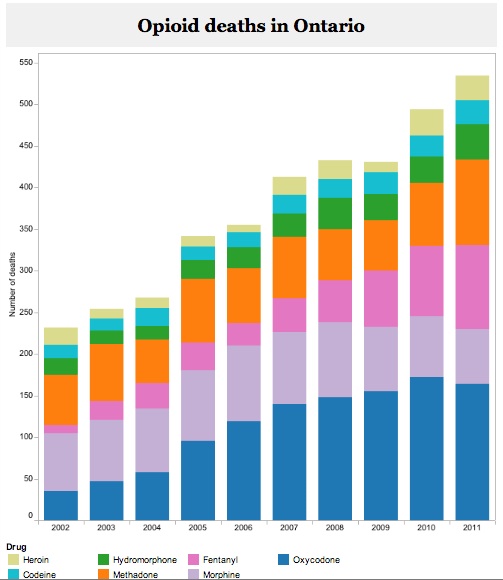
ontario opioid deaths

Anna Mehler Paperny, Global News

Ontario Health Minister Deb Matthews wants to re-examine who’s allowed to prescribe opioids, how they prescribe them and what pills the government pays for.

The drop in OxyContin and its replacement OxyNEO is “a success,” she told Global News in an interview Tuesday. But “there’s more to be done. … Who should be able to prescribe these drugs? What form is the right form? These are very important questions.”

Continue reading

Canada’s the world capital of potent opioids, and that makes its neighbour nervous

Click to compare Canada's hydromorph contin consumption with the rest of the world.

Click to compare Canada’s hydromorph contin consumption with the rest of the world.

Anna Mehler Paperny, Global News

Health Canada rattled nerves south of the border last fall when it approved generic versions of OxyContin.

United States drug czar Gil Kerlikowske issued an alert to law-enforcement agencies, warning that “the potential exists for diversion into the United States because the old formulations, which are easier to abuse, are unavailable in the United States,” the Wall Street Journal reported.

“This alert seeks to raise awareness of this change with law enforcement along the Northern Border so law enforcement and border officials can work jointly to prevent diversion.”

Continue reading

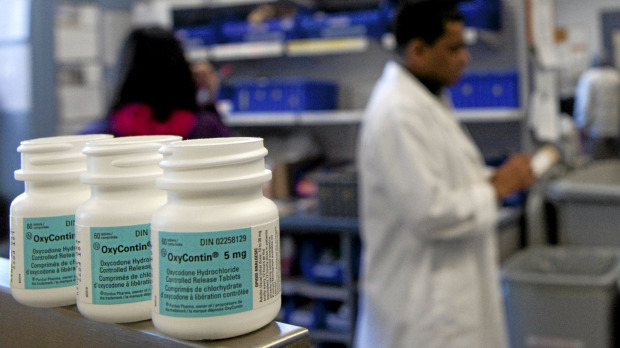
OxyContin’s gone, but Canada’s pill-popping problem is worse than ever

Photo by Michelle Siu for the Globe and Mail

Photo by Michelle Siu for the Globe and Mail

Anna Mehler Paperny, Global News

A year after provincial governments clamped down on the most notorious name in prescription-drug abuse, other, more powerful, less regulated opioids are filling the void – with sometimes fatal results.

OxyContin’s off the market, its tamper-resistant replacement tougher to get. But Canadians are popping more pills than ever: In 2010, for the first time, Canada edged past the United States to become the highest opioid-consuming country, per capita, in the world.

And more Canadians are dying from it: In 2011, twice as many Ontarians were killed by opioid overdoses as drivers killed in car accidents, according to coroner’s statistics given to Global News. That toll has more than tripled since 2002.

Continue reading

Breaking the chrysotile habit: Track the decline of Canada’s asbestos industry

Leslie Young, Global News

In last week’s budget, the federal government promised $50-million over seven years to help diversify the economies of two Quebec towns: Thetford Mines and Asbestos.

Both communities historically relied on asbestos mining as the biggest driver of their economies. And with the decline of the asbestos industry, the local economies have suffered.

But how far has the asbestos industry fallen? According to Industry Canada, the value of Canada’s raw asbestos exports has dropped 94 per cent between 1990 and 2011. Exports alone were worth $645-million in 1990 and fell to $41-million in 2011.

The government’s promised $50-million over seven years represents about 8 per cent of what asbestos exports were in 1990.

Track the fall in an interactive graphic here.

One company, two drugs, two takes on pill safety

Anna Mehler Paperny, Global News

Purdue Pharmaceuticals markets a long-acting, non-tamper resistant opioid in Canada but argues that another long-acting, non-tamper resistant opioid in the U.S. is too dangerous to approve.

In an 80-page submission to the U.S. Food and Drug Administration last July – quoting Ontario Health Minister Deb Matthews, among several others – Purdue argued that allowing generic versions of OxyContin on the market without tamper-proofing mechanisms “would have a number of detrimental effects and would be flatly inconsistent with the Agency’s mission to promote and protect the public health.”

Continue reading