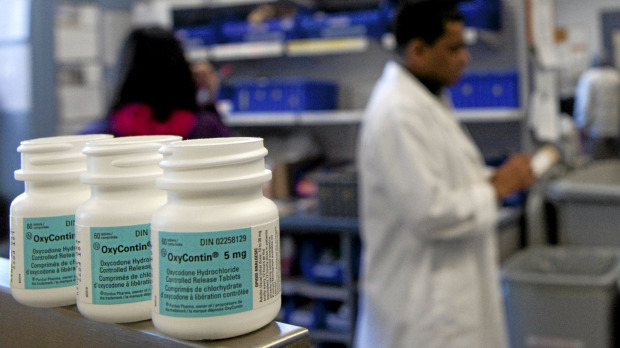
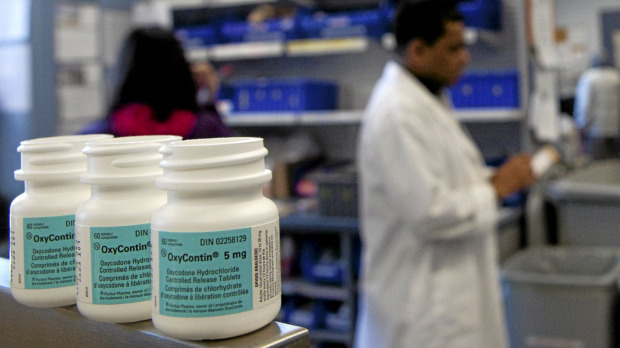
OxyContin’s gone, but Canada’s pill-popping problem is worse than ever

Photo by Michelle Siu for the Globe and Mail

Photo by Michelle Siu for the Globe and Mail

Anna Mehler Paperny, Global News

A year after provincial governments clamped down on the most notorious name in prescription-drug abuse, other, more powerful, less regulated opioids are filling the void – with sometimes fatal results.

OxyContin’s off the market, its tamper-resistant replacement tougher to get. But Canadians are popping more pills than ever: In 2010, for the first time, Canada edged past the United States to become the highest opioid-consuming country, per capita, in the world.

And more Canadians are dying from it: In 2011, twice as many Ontarians were killed by opioid overdoses as drivers killed in car accidents, according to coroner’s statistics given to Global News. That toll has more than tripled since 2002.

Continue reading

Ontario urges feds not to allow generic OxyContin onto market

Michelle Siu for the Globe and Mail

Saturday, July 7, 2012 – Globe and Mail

ANNA MEHLER PAPERNY

Ontario is “strongly urging” the federal government not to let generic brands of the popular painkiller OxyContin into Canada once Purdue Pharmaceuticals’ patent runs out this fall.

The expiration of Purdue’s OxyContin patent on Nov. 25 opens the door for other companies to manufacture cheaper generic versions of the controlled-release oxycodone. Purdue will continue to make a new, tamper-resistant patented drug – OxyNEO – introduced to replace OxyContin earlier this year.

Continue reading

No plans to make Suboxone more easily available in Ontario, Deb Matthews says

Photo by Moe Doiron/The Globe and Mail

Ontario Health Minister Deb Matthews says the province has no immediate plans to put Suboxone on the Ontario Drug Benefit, which would make it more readily available to treat addicts who can’t get methadone, a more common treatment for opioid addiction. Health-care practitioners, especially in remote areas, want to use Suboxone more in cases where there are simply no licensed methadone doctors around, or no spaces available. Buprenorphine, the active ingredient in Suboxone, is supposed to be safer and easier for others (nurses, for example) to give out. It’s also really expensive.

Continue reading

As more drugs crack down on oxycodone abuse, addiction experts fear public insurance limits don’t go far enough

Photo by Michelle Siu for the Globe and Mail

Tuesday, February 21, 2012 – Globe and Mail
ANNA MEHLER PAPERNY

Nova Scotia has become the latest province to clamp down on OxyContin prescriptions, with Health Minister Maureen MacDonald announcing the province will only pay for the potent painkiller’s replacement in extenuating circumstances – for cancer-related pain or palliative care.

Nova Scotia’s move comes days after Ontario, with the highest rates of prescription-opioid addiction in the country, announced it is tightening rules for the painkiller.

Physicians called the move a step forward, but warned that changing publicly funded drug plans won’t be nearly enough to stem abuse from the prescription drug.

“There is a lot more that needs to be done,” said David Juurlink, a drug-safety specialist at Sunnybrook Hospital in Toronto. “These drugs should be harder to obtain, harder to prescribe – and certainly at high doses.”

Continue reading

Provinces clamp down on OxyContin abuse

Photo by Michelle Siu for the Globe and Mail

Saturday, February 18, 2012 – Globe and Mail
ANNA MEHLER PAPERNY

The epicentres of Canada’s prescription pill problem have said they’ll only pay for the leading brand of potent painkillers under special circumstances – one of the most dramatic steps taken in years to tackle the country’s fastest-growing addiction.

Purdue Pharmaceuticals, which manufactures OxyContin, is replacing it with a drug that’s supposed to be less prone to abuse. But some provinces have decided that’s not good enough.

Continue reading

Painkiller deaths double in Ontario

Tuesday, December 8, 2009 – Globe and Mail
ANNA MEHLER PAPERNY

Painkillers are causing twice the number of overdose deaths they were two decades ago, a new study has revealed. And most of those who died obtained the medications through a doctor’s prescription and had seen a physician within the last month of their life.

The increase mirrors a dramatic rise in prescriptions for oxycodone. The potent opiate, found in OxyContin and Percocet, has proliferated in an epidemic of chronic pain turning Canadians into a nation of pill-poppers – using more prescription opioids per capita than any country but the United States and Belgium.

It’s an indication that many doctors have underestimated the power and complexity of prescription opioids, and their ability to harm as well as help, said Irfan Dhalla, a doctor at St. Michael’s Hospital in Toronto and the report’s primary author.

Continue reading

Ontario cracking down on prescription pill abuse

Friday, November 20, 2009 – Globe and Mail

ANNA MEHLER PAPERNY

In the face of Canada’s growing pill problem, Ontario is moving to change the way opioids are prescribed and monitored.

New regulations to be put in place in the coming months would crack down on prescription abuse and set new benchmarks for how these pills should be doled out in an attempt to deal with the growing numbers of people getting hooked on painkillers across the country.

Addiction experts say the changes are badly needed and should have come a decade ago.

Continue reading

Canada, you need an intervention

Saturday, November 14, 2009 – Globe and Mail
ANNA MEHLER PAPERNY

Janey Nagle wasn’t looking for kicks when she began courting a drug habit. The Percocets her doctor prescribed were the only thing that could take away the excruciating pain that lingered a decade after a car accident threw her into a windshield with such force that her face left an imprint in the glass.

For the first two years, the painkillers did the trick. The Perth, Ont., mother of four was able to work and look after her family. But after a while she couldn’t get through the day without the pills’ euphoric effect, and that demanded higher and higher doses.

Fearful her doctor would cut her off, Ms. Nagle looked elsewhere. She spent hundreds of dollars a day on prescription drugs bought off the street, primarily from friends and acquaintances. She photocopied her prescriptions and filled each one repeatedly at pharmacies around Perth, Kingston and Smiths Falls.

“It was a horrible, panicked feeling every morning when I woke up,” says Ms. Nagle, now 43. She remembers the daily dilemma: “How am I going to get them? Where am I going to get the money?”

Continue reading